


First 30 Days of Empty Nest: A Developer’s Survival Guide
Introduction: The Silence in the Server Room
For more than twenty years, your life ran like a production system under constant, heavy load. This wasn’t a development environment. It wasn’t a sandbox where you could test theories without consequence. This was Production. As a parent, your days were governed by high-priority interrupts, complex dependencies, and unexpected hardware failures. You were simultaneously the system architect, the on-call engineer, the incident responder, and the long-term maintainer. You optimized your internal CPU for maximum throughput.
The Human Side: In plain terms, you’ve spent two decades being the person everyone else relied on. Your brain became a 24/7 switchboard, managing everything from school lunches to emotional breakdowns. You didn’t just “have” a family; you were the infrastructure that held it together.
Then, one ordinary day, it ended. You dropped them off at a college dorm or their first apartment. You hugged them goodbye, feeling that strange mix of pride and a hollow ache in your chest. You got back in the car, drove through the familiar streets of your neighbourhood, and opened your front door.
Navigating the first 30 days of empty nest is a unique challenge that feels like a system shock to any parent. The house didn’t feel “peaceful.” It felt offline. The familiar background noise—the slamming of the door, the sound of footsteps on the stairs, the low murmur of a video game in the next room—was gone. The environment felt like a high-density server room after a hard shutdown: the fans silent, the indicator lights dark, the hum of activity replaced by an unsettling, heavy stillness.
If you’ve ever opened Task Manager and seen “System Idle Process” consuming 99% of CPU resources, you understand this feeling exactly. The system isn’t off. It’s awake. It’s waiting. That tightness in your chest is the result of a brain that has been optimized for constant demand suddenly finding itself with zero external load. This is the System Idle Crisis. It is the most volatile phase of the transition, and understanding how to manage the first 30 days of empty nest is the key to a successful “Version 2.0” of your life.
-
The Architecture of Identity: Why We Can’t Just “Turn It Off”
In software development, we understand that systems have dependencies. If you delete a core library, the entire application fails. For two decades, your children were the primary library in your life’s code. Every other function—your career, your marriage, your hobbies, your health—was “called” through the parenting library.
The Human Side: Think of your identity as a house. For 20 years, you’ve been “The Dad” or “The Provider” as the foundation. When the kids leave, it feels like someone pulled the foundation out. You’re still standing, but you feel unstable because you don’t know who you are when no one is asking you for help.
Psychologists refer to this as Identity Foreclosure. When a role that provided 90% of your daily feedback loops disappears, the “Self” enters a state of instability. For a developer, this is like losing your primary database. The UI (your daily life) looks the same, but when you click a button (try to do something meaningful), the system returns a 404 Not Found error. This internal confusion is the hallmark of the first 30 days of empty nest.
-
The Biological Hardware: Neuroscience of the Shutdown
Before we can fix the software, we have to look at the hardware: your brain. The transition isn’t just an emotional event; it’s a neurochemical recalibration that occurs most intensely during the first 30 days of empty nest.
For years, your brain maintained a high baseline of Cortisol (the stress hormone). You needed it to manage the “interrupt-driven” nature of parenting. When the kids leave, the stressors disappear, but your adrenal system doesn’t get the memo. It keeps pumping out Cortisol, looking for a problem to solve.
The Human Side: This is why you feel “jittery.” Your body is prepared for a crisis that isn’t happening. Your brain is still recalibrating during the first 30 days of empty nest, pacing the house or checking your phone every five minutes. Your body is literally looking for a reason to be stressed.
The Oxytocin Withdrawal
Parenting provides a steady stream of Oxytocin (the bonding hormone). A hug, a shared laugh, or even just seeing your child in the kitchen triggers this “feel-good” chemical. When they leave, you go into a form of neurochemical withdrawal. Your “Internal Reward System” is looking for its usual input and finding nothing.
-
Week 1: Managing the First 30 Days of Empty Nest Latency.
In networking, latency is the delay between a command and the response. In Week 1, your body is in the house, but your mind is still “polling” for data from your children.
Identifying Ghost Processes
Ghost processes are background tasks that were once essential but no longer have an endpoint.
- The 3:00 PM Adrenaline Spike: Your brain “wakes up” because that’s when school usually let out.
- The Phantom Sound: You think you hear their voice or the shower running in the other room.
- The Resource Hoarding Error: You find yourself standing in the cereal aisle, reaching for their favourite brand before remembering they aren’t there to eat it.
The Human Side: It’s okay to feel a bit “lost” during the first 30 days of empty nest. You might cry at a commercial or feel a sudden surge of anger because the kitchen is “too clean.” These aren’t signs of a breakdown; they are signs that your heart is still catching up to your new reality.
Survival Strategy: Zero Refactoring
Developer Rule: Never refactor during a system outage. In the first 30 days of empty nest, specifically in Week 1, you will feel an overwhelming urge to make massive life changes. You’ll want to sell the house or quit your job. This is Discomfort Response.
-
The Goal of Week 1 is Uptime. Just keep the basic systems running.
-
Avoid Noise Flooding: Resist the urge to drown out the silence with 24/7 podcasts. If you don’t let the “system” sit in the silence, it can’t recalibrate.
-
Week 2: Debugging the Ghost Habits (Refactoring Deprecated Code)
By the second week, the “shock” has subsided into a dull, persistent realization that the old way of living is gone. This is where you begin the Debugging Phase of the first 30 days of empty nest.
Cataloguing Deprecated Habits
Identify the “scripts” you are running that no longer serve a purpose:
- The Laundry Loop: Walking past their room to check for a pile of clothes out of pure muscle memory.
- The Kitchen Polling: Checking the fridge four times an hour, subconsciously looking for something that “needs” to be cooked.
- The Digital Hovering: Refreshing their Instagram stories or checking their “Find My Friends” location every 15 minutes.
The Human Side: Think of these as “Phantom Limb” sensations. You’ve been a parent for so long that your brain still thinks that limb is there. When you catch yourself doing these things during the first 30 days of empty nest, don’t be hard on yourself. Just smile, acknowledge the habit, and gently turn your attention elsewhere.
Implementing Manual Overrides
You cannot “delete” these habits; you can only overwrite them.
- Change the Order of Operations: If you always checked their room first thing, change your route. Go straight to the backyard or the coffee machine.
- Update the “Grocery Script”: Intentionally buy the “Small Batch” version of everything. Buying a small carton of milk for the first time will feel like a “syntax error” in your brain, but it’s a necessary update.
-
Week 3: Optimizing the Routine in the First 30 Days of Empty Nest
By Day 15, the “System Idle” state starts to shift from anxiety to Sprawl. Without the hard deadlines of a busy household, your days might begin to feel aimless. As I mentioned in my [Phase 2 Blueprint], starting with a clear plan is the best way to handle the transition.
Designing Your “Morning Boot Sequence”
As you optimize your routine in the first 30 days of empty nest, focus on small wins. In the absence of external pressure, you must create Internal Anchors.
- Input (30 mins): No screens. Read a physical book, meditate, or sit with your thoughts.
- Processing (40 mins): Physical movement. This “burns off” the residual Cortisol.
- Output (20 mins): Plan the one “High-Priority Ticket” (the most important task) for the day.
The Human Side: Routine is your best friend when you’re feeling lost. Even if it’s just making the bed and taking a walk at the same time every morning, these small “anchors” keep you from drifting into a sea of “what-ifs” and sadness during the first 30 days of empty nest.
-
Week 4: Completing the First 30 Days of Empty Nest Transition.
By the final week of the first month, you have reclaimed roughly 15–20 hours of cognitive bandwidth per week. If you don’t fill this bandwidth intentionally, it will fill with worry. It’s time for your first Phase 2 Deployment.
Choosing a Low-Risk Project
Your first post-parenting project shouldn’t be your “Life’s Work.” It should be a Beta Test. * The Physical Refactor: Turn the “Kid’s Cave” or a cluttered guest room into a high-performance studio or office.
- The Personal Wiki: Start documenting something you’ve always been interested in—genealogy, a new coding language, or a travel plan.
- The Hands-On Build: Developers spend a lot of time in the digital world. Try something physical. Woodworking, gardening, or restoring an old piece of furniture.
The Human Side: You’ve spent 20 years building someone else’s life. This is the week you start building your own again. It doesn’t have to be perfect; it just has to be yours.
-
Refactoring the Marriage API: Reconnecting Without the “Project”
For most couples, children were the “Central Project.” For 20 years, 80% of your conversations were about logistics. Reconnecting as a couple is a priority during the first 30 days of empty nest.
Unit Testing Your Connection
- The “No-Kid Zone” Date: Go out to dinner and establish a “Hard Firewall.” If anyone mentions the kids, you have to buy the other person a gift or a drink. It will be awkward. You might sit in silence.
- The Human Side: That silence is okay. It’s the sound of two people learning who they are without their “Mom” and “Dad” masks on. Don’t be afraid of the quiet; use it to look at your partner and really see them again.
-
Legacy Data Management: Handling the “Memories” Cache
One unexpected challenge of the first 30 days of empty nest is the “Memory Overflow.” You’ll find yourself looking at an old toy or a height chart on a doorframe and feel a sudden, overwhelming crash of nostalgia.
The Developer Approach to Memories
Treat these as Legacy Data. They are valuable, but they shouldn’t slow down your current “Live Environment.”
- Create a Secure Archive: Instead of leaving the house exactly as it was (which keeps the system in a “Frozen State”), start a project to digitize old photos or create a memory box.
- Data Migration: Shift those memories from “Painful Reminders” to “Successful Milestones.” Every photo is proof of a mission accomplished.
-
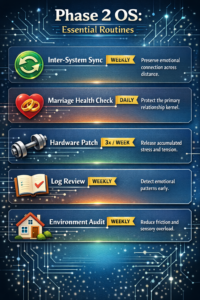
The 30-Day Phase 2 Maintenance Checklist
| Task | Frequency | Technical / Human Purpose |
| Inter-system Sync | Weekly | A scheduled call with kids. Prevents “Packet Loss” (distance). |
| Marriage Health Check | Daily | 15 mins of conversation unrelated to kids. |
| Hardware Patch | 3x/Week | Physical exercise to “flush” the stress buffers. |
| The “Log” Review | Weekly | Journaling. Review what “bugs” (emotions) popped up this week. |
| Environment Audit | Weekly | Optimize one physical space to reduce “Visual Noise.” |
10. FAQ: Common Bugs in the First 30 Days of Empty Nest
Absolutely. You are transitioning out of a 20+ year "Operating System." It takes time to install the new one. Identity shifts are not instant; they are iterative. No. Relief and sadness are not mutually exclusive. You can be proud of your child's independence while being relieved that you no longer have to manage their daily drama during the first 30 days of empty nest. Think of it as Permission Management. Your child has moved to a new "Server." You no longer have "Admin Rights" to their daily movements. Move their icon to a secondary screen on your phone.Is it normal to feel lost during the first 30 days of empty nest?
I feel guilty for enjoying the quiet. Is my “Moral Compass” buggy?
How do I stop “Location Hovering” on my phone?
Conclusion: Version 2.0 Is a Choice
The first 30 days of the empty nest transition are the most difficult because you are essentially “un-installing” a life that took 20 years to build. There will be glitches. There will be crashes. There will be nights when you sit in the dark and want to revert to a previous version of your life.
But here is the secret of the “System Idle Crisis”: The bandwidth isn’t gone; it’s just available. By the end of the first 30 days of empty nest, a new reality emerges: the system isn’t broken, it’s efficient. You have more focus, more potential, and more power than you’ve had since you were in your twenties.
The System is live. The bandwidth is yours. Phase 2 has begun.
What are you going to build next?
I want to hear your Debug Logs: What was the strangest “ghost habit” you caught yourself running during your first week? Let’s compare notes in the comments below.
