

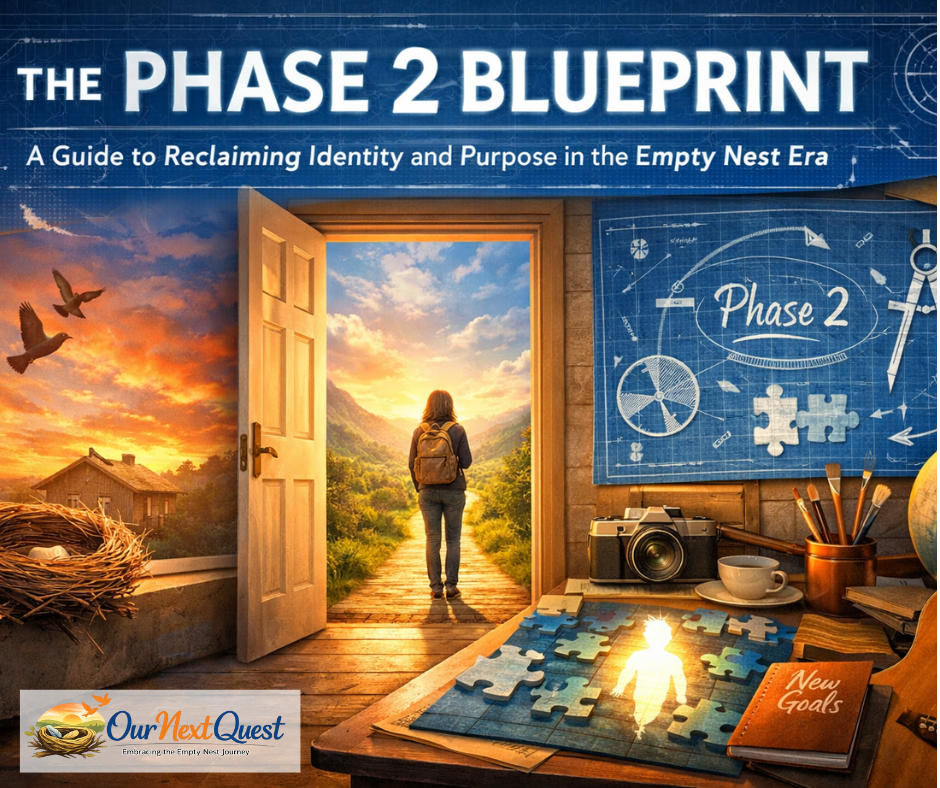
The Phase 2 Blueprint: A Developer’s Guide to Reclaiming Identity and Purpose in the Empty Nest Era
Introduction: When the Noise Stops
For most of my adult life, everything ran on systems.
I live in the U.S., and I’ve spent over 15 years working as a software developer. My career has been defined by planning complex migrations, fixing broken processes, and helping global teams survive major infrastructure upgrades. I understood systems deeply: how they behave under heavy load, what happens when critical dependencies suddenly disappear, and why even the most well-designed structures can feel unstable during a version change.
Still, nothing in my professional life prepared me for the quiet.
The day my oldest child moved into their college dorm, the silence didn’t arrive with a bang. It crept in slowly—during the drive home, looking at the empty backseat in the rearview mirror, and finally, in the absence of background noise I hadn’t even realized I was relying on for my daily rhythm.
When I walked back into the house, the atmosphere had shifted. It wasn’t “bad,” and it wasn’t “good.” It was simply… hollow.
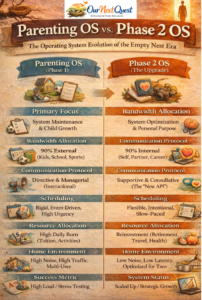
For over twenty years, my life ran on what I now call the Parenting Operating System (POS). It organized my calendar, shaped my core identity, and gave every single hour a clear, high-priority ticket. Then, almost overnight, the server went offline. The system shut down.
If you’re in that space now—standing in your kitchen, scrolling your phone, unsure why you feel so disoriented even though everything is technically “fine”—understand this: this isn’t a bug. It’s a transition.
This article is a deep, practical, and human empty nest transition guide for parents entering Phase 2. This is that stretch of time after the kids move out, when the structure disappears and the question “Who am I now?” finally has the “bandwidth” to surface.
Why the Empty Nest Transition Feels So Much Bigger Than We Expect
Many parents are caught off guard by the intensity of Empty Nest Syndrome. After all, this was always the goal, wasn’t it? We spent decades working to ensure our children would grow up, become independent, and build lives of their own. When they finally do, we expect to feel nothing but pride and relief.
Yet, many of us feel a profound sense of disorientation. Why?
The reason is simple but rarely discussed in tech circles or social gatherings: parenting doesn’t just take up your time—it provides your identity.
Psychologists have long noted that caregiving roles create meaning, structure, and social validation. According to identity development theory, when a major life role ends, people experience a temporary loss of self—even when the change is a positive milestone.
In plain language: * You didn’t just lose daily contact with your child.
- You lost the version of yourself who always knew exactly what to do next.
This is why life after kids move out feels like a system with no “init” script. The calendar opens up. The urgency disappears. The mental noise quiets—and suddenly, you’re left alone with questions you haven’t had time to ask in twenty years.
-
Identity After Parenting: When the Role You Lived In Changes
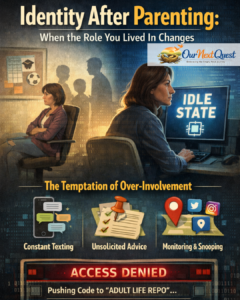
In software engineering, when a long-running process stops, the CPU doesn’t just stop working—it enters an “idle state.” But humans aren’t built for prolonged idling.
For decades, your internal bandwidth was consumed by the “Parenting OS.” Every decision was filtered through a primary query: “How does this affect the kids?” When that filter is removed, the sudden abundance of mental and emotional energy can feel uncomfortable, even anxiety-inducing.
The Temptation of Over-Involvement
Many parents respond to this “idle state” by trying to force their way back into the old system. They stay “over-logged” into their children’s lives via:
- Constant, high-frequency texting.
- Giving unsolicited advice on every minor life choice.
- Monitoring social media or location apps under the guise of “safety.”
Family systems research shows that this over-involvement during early adulthood can actually delay a child’s independence and increase friction on both sides. In developer terms: you are trying to push code to a repository you no longer have “write access” to.
Letting go isn’t about disengaging; it’s about redefining your role from Lead Architect to Consultant.
Emotional Whiplash: The Complexity of Relief and Sadness
One of the most confusing parts of being an empty nester is the emotional contradiction. You are proud of your child, relieved to have a cleaner house, sad when you walk past their room, and guilty for enjoying the peace—all within the same ten-minute span.
This isn’t “emotional inconsistency.” It is what Psychologist Dr. Pauline Boss calls “Ambiguous Loss.” This occurs during role transitions where something meaningful has changed, but there is no clear “ending” like a funeral.
You aren’t mourning the loss of your child (they are still there!). You are mourning the decommissioning of a version of your life.
What helps most:
- Naming the feeling: Acknowledge it as “transition grief.”
- Creating Rituals: Whether it’s a long walk, journaling, or a new hobby, create a “Phase 2” routine.
- Acknowledging Relief: It is okay to be happy that you don’t have to do three loads of laundry every day.
Refactoring Marriage in the Empty Nest Years
For many couples, the children become the “central project” that holds the relationship infrastructure together. Schedules, logistics, and co-parenting duties slowly replace genuine intimacy. You become great “Project Managers,” but you stop being “Partners.”
When the project ships (the kids leave), many couples find they have been living in Parallel Processing mode—occupying the same house but running entirely different threads. Research in the Journal of Marriage and Family shows that while marital satisfaction often dips right after the nest empties, it improves significantly for those who intentionally re-factor their connection.
The Developer’s Playbook for “Phase 2” Date Nights
To avoid “System Stagnation,” you need to introduce new inputs into the relationship. Here are a few “Developer-themed” ways to reconnect:
- The “New Tech Stack” Date:
Choose a skill neither of you knows—perhaps pottery, pickleball, or a foreign language. The goal isn’t mastery; it’s the shared experience of being “Junior Developers” in a new field. This builds a shared “codebase” of new memories. - The “Legacy Migration” Evening:
Set aside one night to go through old digital archives or physical photo albums. Instead of just looking at the kids, look at photos of the two of you before the kids arrived. It’s a way to recover “deprecated” parts of your romantic identity. - The “Beta Test” Dinner:
Pick a neighborhood or a cuisine you’ve never tried. Approach it like a beta test—critique the “UI” (the atmosphere), the “UX” (the service), and the “Output” (the food). It turns a simple meal into a collaborative project. - The “Vision Sprint” Retreat:
Take a weekend away not for vacation, but for a “Product Roadmap” session for your lives. What do you want your 60s to look like? Where do you want to live? Aligning your “System Requirements” for the future reduces friction later.
Hardware Upgrades: Your House Is Different Now
The empty bedroom hits differently than most people expect. It isn’t just a room; it’s a symbol of a completed era.
Many people immediately jump to downsizing for empty nesters, but housing researchers suggest that emotional readiness matters more than square footage. Don’t rush into a move during the first six months. Instead, consider an “Internal Migration.”
Repurposing with Intention:
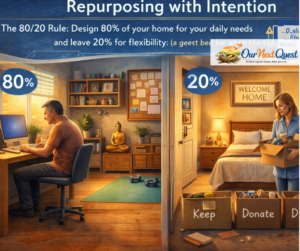
- The 80/20 Rule:
Design 80% of your home for your daily needs (that home office or yoga studio you always wanted) and leave 20% for flexibility (a guest bed for when the kids visit). - De-cluttering:
This is the perfect time to “clean up the codebase” of your home. Get rid of the physical items that belong to a version of you that no longer exists.
The Scheduler: Why Time Feels Strange
Without school drop-offs, sports practices, and dinner deadlines, time starts to “drift.” Evenings feel long. Weekends can feel aimless.
Neuroscience shows that humans thrive on rhythm. When your external structure disappears, your nervous system feels unsettled. To fix this, you need to design a gentle structure.
Establish “Anchors” for your day:
-
-
- Movement: A morning walk or gym session.
- Learning: Time dedicated to a new skill or hobby.
- Social: A weekly coffee or call with a friend.
- Deep Work/Rest: Intentional time for your career or recovery.
-
Career 2.0: Professional Clarity in Phase 2
As a developer, I know that when the “home demands” on your local machine decrease, the CPU can handle much more complex tasks. Many empty nesters find that their career goals shift dramatically during this time.
Without the need to maximize every penny for college tuition or handle mid-day school emergencies, you can ask: “Do I still want this career? Or do I want a role that provides more meaning?”
Studies from Encore.org show a massive rise in “Phase 2” careers—mentorship, consulting, and purpose-driven work—among adults over 50. This isn’t about retiring; it’s about re-deploying your skills where they matter most to you.
The New API: Communicating with Adult Children
Your relationship isn’t ending; it’s undergoing a major version upgrade. Family psychologists recommend moving from “Directive Parenting” (telling them what to do) to “Supportive Availability” (being there when they ask).
The “Phase 2” Communication Protocol:
-
-
- Less Frequency, Higher Quality: A weekly scheduled video call is often more meaningful than ten daily “How are you?” texts.
- Listening > Debugging: When they call with a problem, don’t immediately try to fix it. Ask: “Do you want me to listen, or do you want me to help you brainstorm a solution?”
Building a Social Circle Beyond Parenting
-
Most adult friendships are “logistics-based.” You become friends with the parents of your kids’ friends. When the kids leave, those social circles often dissolve.
Research from the Pew Research Center highlights that adult friendships thrive when built on shared values rather than shared logistics. This is your chance to find “your people”—people who like you for your interests, not your children’s soccer schedule.
Health as Infrastructure, Not an Afterthought
When you were a young parent, your health was likely at the bottom of the priority list. In Phase 2, health becomes your primary infrastructure.
The CDC notes that midlife is the critical window for establishing habits that prevent long-term decline. Focus on functional strength, cardiovascular health, and—most importantly—sleep. You finally have the “system resources” to take care of yourself.
Financial Refactoring: Allocating Resources
With the “Daily Child Expense” variable removed from your budget, many parents feel a sudden surge in disposable income. Financial planners recommend a “System Audit”:
-
-
- Max out retirement catch-up contributions.
- Pay down long-term debt.
- Invest in “Experiences” over “Assets”: Research shows that for those over 50, travel and learning provide a much higher “Return on Investment” for happiness than buying more physical goods.
-
Purpose After Parenting: The Core Kernel Question
Eventually, the practical noise settles, and you are left with the most important question of all: “What gives my life meaning now?”
Research from Stanford’s Center on Longevity shows that adults who pursue a “Purpose Beyond Self” experience greater cognitive health and life satisfaction.
Purpose isn’t something you “find” like a lost set of keys. Purpose is something you design. Whether it is volunteering, writing, starting a small business, or mentoring junior developers, your “Phase 2” is your chance to write the code exactly how you want it.
The Phase 2 Checklist: A Comprehensive Audit for Empty Nesters
Transitioning into this era requires more than just emotional readiness; it requires a systematic audit of your life. Use this checklist to ensure your “System Upgrade” is successful.
1. The Relationship & Social Audit
-
-
- Schedule a “State of the Union”: Sit down with your partner and discuss fears and excitement about the quiet house.
- The 3-2-1 Communication Rule: Establish a protocol with your adult children. (e.g., 3 texts a week, 1 video call, 2 visits a year).
- Audit Your Friends: Identify 3 people you enjoy spending time with outside of kid-related activities. Reach out and schedule a “non-parenting” meetup.
- Apologize for “System Over-Involvement”: If you’ve been hovering, send a short text to your child: “I’m learning how to be a consultant rather than a manager. I’m here if you need me, but I trust your judgment.”
-
2. The Infrastructure (Home) Audit
-
-
- Decommission “Ghost” Items: Donate old toys, outgrown clothes, and broken gear. If a room hasn’t been used in 3 months, it needs a new purpose.
- Convert the “Base of Operations”: Turn one unused bedroom into a “Growth Room”—a dedicated space for your hobbies, whether that’s a coding lab, an art studio, or a meditation space.
- Safety Patching: As we age, home safety matters more. Check lighting in hallways, fix loose rug edges, and ensure your “Hardware” (the house) supports your long-term health.
-
3. The Financial & Career Audit
-
-
- Redirect the “Tuition Stream”: Now that college or daily child expenses are decreasing, automate that money into a high-yield savings account or retirement “catch-up” fund.
- Update Beneficiaries: Ensure your “Permissions” (wills, life insurance, 401k beneficiaries) are up to date for this new phase.
- The “Passion Project” Query: If money weren’t the primary driver, would you still be at your current job? List three “side-projects” or consulting roles you’d like to explore.
-
4. The Wellness (Health) Audit
-
-
- Schedule a Full System Scan: Get that comprehensive physical you’ve been putting off while you were busy with the kids.
- Standardize Your “Uptime”: Focus on a sleep schedule. Without late-night teen arrivals, you can finally optimize your circadian rhythms.
- Strength Training: Muscle mass is the “RAM” of the human body as we age. Start a resistance training program 2–3 times a week to maintain your physical “performance.”
-
Frequently Asked Questions
Is it normal to feel lost or “empty” during this phase?
Absolutely. You are transitioning out of a 20+ year “Operating System.”
When a defining role ends, disorientation is a natural response—even when the change is positive.
How long does the adjustment period usually last?
Most empty nesters report settling into a “new normal” within 12 to 24 months.
Emotional waves may still surface around holidays, milestones, or visits—and that’s normal.
Should I sell my house immediately?
Usually not. Experts recommend waiting at least a year before making major decisions,
ensuring you’re acting from clarity rather than transition-driven emotion.
Can the empty nest actually improve my marriage?
Yes. Many couples experience renewed intimacy and connection once they intentionally
shift from child-centered logistics to relationship-centered design.
Conclusion: Phase 2 Is a Beginning, Not an Ending
The empty nest is often framed as a period of decline or “fading away.”
It isn’t. It’s a successful launch.
You did what you were supposed to do. You raised someone strong enough to leave you. That achievement carries a quiet kind of grief, but it also carries immense pride.
This empty nest transition guide isn’t about just “getting over it.” It’s about recognizing that for the first time in decades, the system is live, the bandwidth is yours, and the administrator password belongs to you.
Phase 2 has begun. What are you going to build?
I want to hear from you: What was the one thing that surprised you most when your house went quiet? Share your “debug log” in the comments below!
